
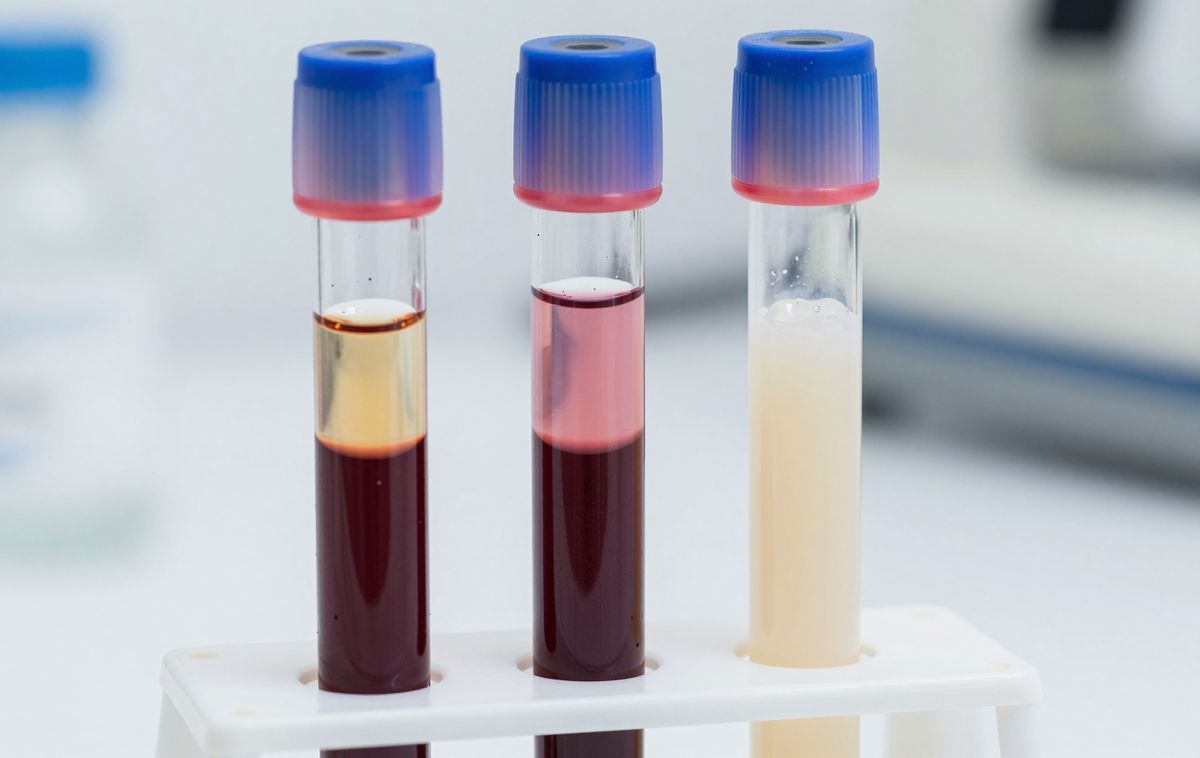
In short. Normal plasma after centrifugation is clear and straw-yellow. A pink or red colour means the plasma contains red cells or haemoglobin from destroyed red cells: most often haemolysis during the draw or aspiration too close to the cell layer. Milky cloudiness usually follows a fatty meal before the draw. Too little plasma comes from a high haematocrit, an incomplete draw or insufficient centrifugation. The table below shows what you see, why it happens and what to check next time.
What plasma should look like
In a tube with separator gel there are three layers after centrifugation: clear yellow plasma on top, gel in the middle, blood cells at the bottom. Right above the gel the plasma may look slightly hazier, because platelets gather there, and that is normal. The shade of yellow varies between people and does not signal a defect by itself.
What you see and what it means
| What you see | Likely cause | What to check |
|---|---|---|
| Pink or red plasma that stays pink when the tube stands | Haemolysis: red cells were destroyed during the draw or handling | Needle, repeated punctures, shaking, temperature |
| Red tint or sediment at the boundary that settles down | Intact red cells got into the plasma | Whether the gel rose, centrifuge settings, careful aspiration |
| Milky cloudiness throughout the plasma | Lipaemia: a lot of fat in the blood after eating | When and what the patient ate before the procedure |
| Dark yellow or orange plasma | High bilirubin in the patient's blood | A property of the blood, not the tube, the physician decides |
| Clots or strands in the plasma | Blood did not mix with the citrate or filled the tube too slowly | Inversion right after the draw, draw speed |
| Too little plasma | High haematocrit, underfilled tube, too few revolutions or too short a spin | Blood level in the tube, expiry date, centrifuge settings |
| Gel did not rise or the boundary is ragged | Too few revolutions or too short a spin, cold tube | Settings from the instructions, storage conditions |
Red plasma: haemolysis or red cells
These are two different cases and they are easy to tell apart. If intact red cells got into the plasma, they gradually settle and the plasma above them clears. If haemolysis happened, the haemoglobin is already dissolved in the plasma and it stays pink however long the tube stands.
Haemolysis almost always happens before the centrifuge, during the draw and handling of the tube. A review of haemolysis causes (Biochem Med, 2015) lists needle size and vein choice, turbulent blood flow into the tube and repeated punctures, too small a blood volume in the tube, vigorous shaking instead of gentle inversion, overheating or overcooling of the tube and errors during centrifugation. Haemoglobin cannot be removed from plasma, only a new draw helps.
Red cells in the plasma usually appear during aspiration: the needle came too close to the boundary, the gel did not form a solid layer or the centrifuge did not reach its settings. The rule is simple: better to leave a millilitre of plasma behind than to touch the cells. Whether plasma with a pink tint can be used is decided by the physician according to their protocol.
Cloudy plasma
The most common cause of milky plasma is a fatty meal shortly before the draw: the blood carries many fat particles and they stay in the plasma. A review of blood sample quality (Eur J Trauma Emerg Surg, 2025) names non-fasting collection as the most common cause of lipaemia. That is why patients are usually asked to avoid fatty food before the procedure, while the exact preparation rules are set by the physician. A slight haze right above the gel is platelets, not a defect.
Why there is little plasma
The main factor is the patient's haematocrit, the share of cells in the blood. The higher it is, the less plasma remains above the gel. The table shows how much plasma theoretically sits above the cells in a tube holding 8 ml of blood. The calculation leaves out the anticoagulant and the gel, and in practice less is aspirated, leaving a margin above the boundary.
| Haematocrit | Plasma in a tube with 8 ml of blood |
|---|---|
| 35 % | about 5.2 ml |
| 40 % | about 4.8 ml |
| 45 % | about 4.4 ml |
| 50 % | about 4.0 ml |
| 55 % | about 3.6 ml |
The difference between patients with a haematocrit of 35 and 55 % is almost one and a half millilitres per tube. If the first tube shows little plasma, the physician takes another one from the same draw. How many tubes to plan per procedure is covered in the article on the number of tubes per PRP procedure.
The second cause is an incomplete draw. A vacuum tube fills until the vacuum is equalised and then stops by itself. If the blood stopped earlier, the vacuum was partly lost (expired tube, storage outside the instructions, damaged cap) or the draw was interrupted: the needle moved or the vein collapsed. Underfilling also shifts the blood to citrate ratio the tube is designed for. The third cause is insufficient centrifugation: the cells have not settled and the boundary is blurred.
Can blood be poured from one tube into another
No. The question whether blood from a yellow gel tube can be transferred into a lavender one comes up often, but these tubes have different purposes. A yellow or gold cap on laboratory tubes means a clot activator and gel for serum, and blood starts clotting in it immediately. A lavender cap means EDTA. Transferring mixes the additives, upsets the blood to reagent ratio and does not turn the tube into a PRP tube. Blood for PRP is drawn straight into a tube intended for PRP. How to read cap colours is explained in the article on blood tube cap colours.
What to check with a ReLife tube
- Expiry date and storage conditions from the instructions: they determine the vacuum and therefore a complete draw.
- Blood should flow into the tube by itself until it stops. If it stopped early, it is better to replace the tube.
- Right after the draw the tube is gently inverted as the instructions say, without shaking.
- Centrifuge settings from the instructions. We send protocol parameters for each field to physicians on request from the protocols page.
- Aspirate plasma with a margin above the gel without touching the boundary. Why the tube has a gel is explained in the article on tubes with and without gel.
The ReLife PRP 8 ml tube: glass, vacuum, sodium citrate and separator gel, blue cap, safety class 2b, Registration certificate RK-MP-5№016078.
Frequently asked questions
Will a second spin help if the plasma is red?
Not with haemolysis: the haemoglobin is already dissolved in the plasma. Intact red cells settle by themselves, and whether a gel tube may be spun again is stated in its instructions.
Why is one patient's plasma darker than another's?
The shade depends on the composition of the blood, for example the bilirubin level. It is not a sign of a defective tube. If a patient's plasma is noticeably dark or orange, the physician assesses the situation.
Is it normal for the plasma near the gel to be hazier than at the top?
Yes. More platelets gather near the gel, so the lower part of the plasma may look slightly denser. Milky cloudiness through the whole column is something else, most often lipaemia.
Sources
- Confidence level in venipuncture and knowledge on causes of in vitro hemolysis among healthcare professionals. Biochemia Medica, 2015. doi.org/10.11613/BM.2015.040
- Influence of hemolysis, lipemia and bilirubin on biobank sample quality. European Journal of Trauma and Emergency Surgery, 2025. doi.org/10.1007/s00068-025-02822-w