
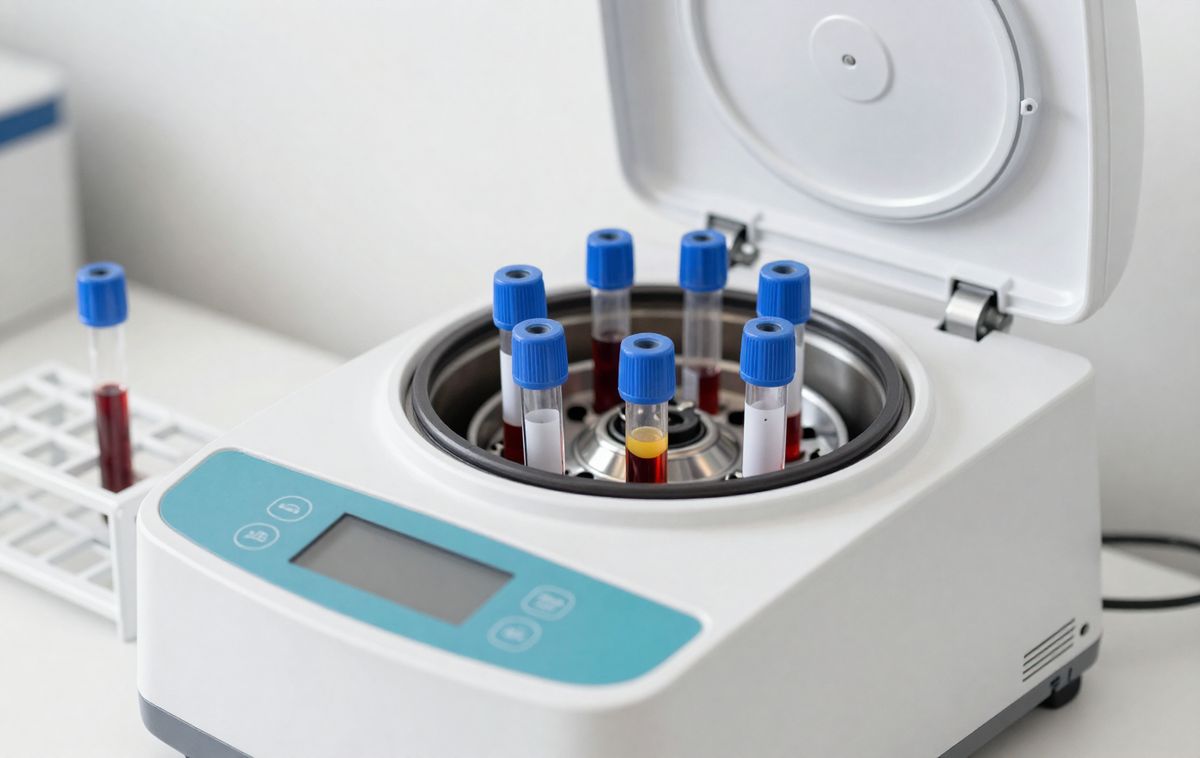
In short. What matters for PRP is not the speed but the acceleration the blood receives, measured in g. The same 3000 revolutions per minute give about 805 g on a rotor with an 8 cm radius and about 1509 g on a 15 cm rotor, almost twice as much. A setting written in RPM means nothing without the rotor radius. Below are the formula, a calculator and conversion tables, plus the settings described in studies.
RPM and g: the difference
A centrifuge displays its speed in revolutions per minute. But blood is separated not by speed as such but by centrifugal acceleration, which also depends on how far the tube sits from the axis. This acceleration is expressed as relative centrifugal force, RCF, in units of g. The formula is given in a review of PRP preparation methods (J Cutan Aesthet Surg, 2014):
g = 1.118 × 10⁻⁵ × R × N², where R is the rotor radius in centimetres from the axis to the tube and N is revolutions per minute.
The radius is listed in the centrifuge or rotor manual, usually as the maximum radius to the bottom of the tube. Without a manual, measure it with a ruler from the centre of the rotor to the bottom of an inserted tube.
Calculator: RPM to g and back
- 1006 gat this speed and radius
- 1890 rpmneeded for the required acceleration
How many RPM for the g you need
The table uses the same formula for four typical rotor radii of benchtop centrifuges. RPM values are rounded to tens.
| Acceleration | Radius 8 cm | 10 cm | 12 cm | 15 cm |
|---|---|---|---|---|
| 100 g | 1060 | 950 | 860 | 770 |
| 200 g | 1500 | 1340 | 1220 | 1090 |
| 400 g | 2110 | 1890 | 1730 | 1540 |
| 800 g | 2990 | 2680 | 2440 | 2180 |
| 1000 g | 3340 | 2990 | 2730 | 2440 |
| 1500 g | 4100 | 3660 | 3340 | 2990 |
And the reverse: the acceleration that common speeds give on different rotors.
| RPM | Radius 8 cm | 10 cm | 12 cm | 15 cm |
|---|---|---|---|---|
| 1500 | 201 g | 252 g | 302 g | 377 g |
| 2000 | 358 g | 447 g | 537 g | 671 g |
| 3000 | 805 g | 1006 g | 1207 g | 1509 g |
| 4000 | 1431 g | 1789 g | 2147 g | 2683 g |
Which settings studies describe
There is no single setting for PRP, and studies vary widely. A telling example is a study of the centrifugation step in PRP preparation (ISRN Hematology, 2014), in which blood was spun in tubes without gel in two steps. For the first spin the authors tested accelerations from 50 to 820 g for 10 minutes each: the most platelets stayed in the plasma at 70-100 g, and the yield fell beyond that. A setting of 100 g for 10 minutes recovered 70-80 % of platelets, and the result was repeated with 20 donors. For the second spin, 400 g for 10 minutes gave a fivefold concentration, while at 800 and 1200 g markers of platelet activation rose, meaning some platelets were damaged before injection.
The authors note that many studies give settings in RPM rather than in g, which makes them impossible to compare or reproduce without the rotor radius. The 2014 review reaches the same point: calculating g always depends on the rotor of the specific centrifuge.
These figures apply to the two-step technique without gel and are not a setting for gel tubes.
Tubes with separator gel
A gel tube is usually spun once, and its setting is defined by the manufacturer: the gel has to rise and form a solid layer between plasma and cells. If acceleration or time was not enough, the gel does not form a continuous boundary and red cells get into the plasma. What that looks like and what to check is covered in the article on red and cloudy plasma.
The rule is simple: the setting in the instructions is given in g or in RPM for a specific rotor, and it has to be converted to your own centrifuge with the calculator above. Settings taken from another centrifuge at a seminar or in a chat give a different acceleration. The setting for ReLife tubes is in the instructions, and we send protocol parameters for each field to physicians on request from the protocols page. Why the tube has a gel is explained in the article on tubes with and without gel.
Frequently asked questions
Can I use a colleague's setting if they have a different centrifuge?
Only after conversion. Write the colleague's setting in g using their rotor radius, then convert that g into RPM for your rotor. The same RPM on different centrifuges gives different acceleration.
Where do I find the rotor radius?
In the centrifuge or rotor manual, often listed as the maximum radius. Without a manual, measure from the centre of the rotor to the bottom of an inserted tube.
What matters more, time or acceleration?
Both, and they are set together. Studies always describe a setting as a pair, for example 100 g for 10 minutes, and one cannot be changed without the other.
Sources
- Dhurat R, Sukesh M. Principles and methods of preparation of platelet-rich plasma: a review and author's perspective. Journal of Cutaneous and Aesthetic Surgery, 2014. doi.org/10.4103/0974-2077.150734
- Perez AGM et al. Relevant aspects of centrifugation step in the preparation of platelet-rich plasma. ISRN Hematology, 2014. doi.org/10.1155/2014/176060