
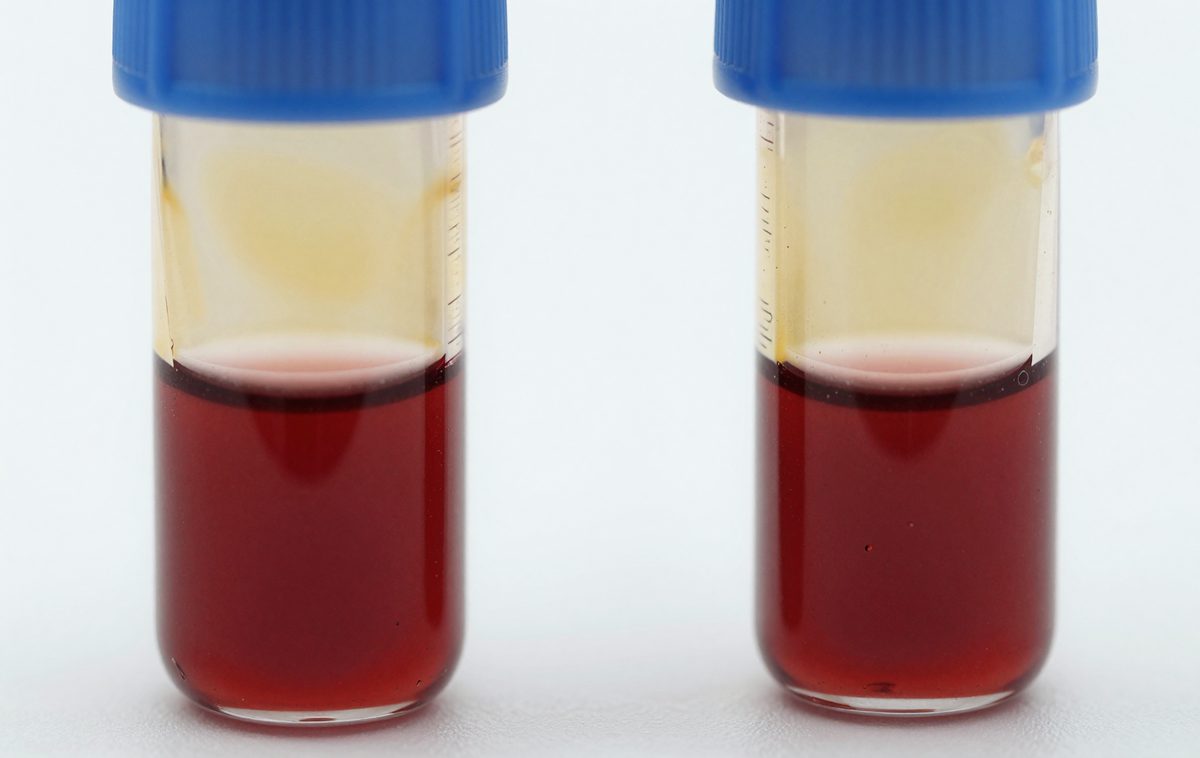
In short. Gel and sodium citrate are not rivals: citrate keeps blood from clotting, gel settles as a barrier between plasma and cells after centrifugation. The ReLife tube contains both. A gel tube gives plasma in a single spin with little risk of drawing red cells. A tube without gel takes more manual work but lets the physician decide how much of the cell layer to collect. Neither is better, they are different techniques for different protocols.
What a separator gel is
It is an inert polymer whose density lies between that of plasma and that of blood cells. Before centrifugation it sits at the bottom. During the spin the cells move down, the gel rises between them and the plasma, and after the spin it firms up again and holds the boundary. The tube can then be tilted and plasma drawn without stirring up red cells. The gel does not dissolve in plasma and does not reach the syringe when the centrifuge settings from the instructions are followed.
Working with a tube without gel
Without gel the spun tube shows three layers: plasma on top, a thin whitish layer of leukocytes and platelets in the middle and red cells at the bottom. The physician collects plasma by hand, keeping clear of the boundary. Many protocols use two spins, the first to separate plasma and the second to concentrate platelets. It takes longer and depends more on technique, but it allows collecting part of the middle layer on purpose when a leukocyte-rich PRP is required.
Comparison
| With gel | Without gel | |
|---|---|---|
| Spins | Usually one | Often two |
| Time per tube | Shorter | Longer |
| Risk of drawing red cells | Low, the gel holds the boundary | Depends on experience |
| Reproducibility | Higher, fewer manual steps | Depends on technique |
| Plasma composition | Usually leukocyte-poor | Leukocyte-poor or leukocyte-rich |
Are gel tubes worse than citrate tubes?
The question comes from a mix-up. In laboratories a gel tube usually means a gold or yellow serum tube with a clot activator and gel, in which blood clots, and that tube indeed cannot be used for PRP. A PRP gel tube contains sodium citrate as the anticoagulant and gel as the separator, so comparing it with a citrate tube makes no sense: it is one. How to tell them apart by cap and label is covered in blood tube cap colours.
The ReLife tube
ReLife PRP 8 ml: glass, vacuum, sodium citrate and separating gel, blue cap, class 2b, Registration certificate RK-MP-5№016078. Centrifuge settings are in the instructions, protocol parameters are sent to physicians on request from the protocols page. Specifications are on the product page.
Frequently asked questions
Can gel get into the plasma?
With the centrifuge settings from the instructions the gel forms a firm layer and stays below the plasma. If it did not rise or the boundary is uneven, speed or time was usually off.
Does a gel tube need a second spin?
Usually not, gel tubes are designed for one. Some protocols concentrate the plasma afterwards, which is the physician's decision.