
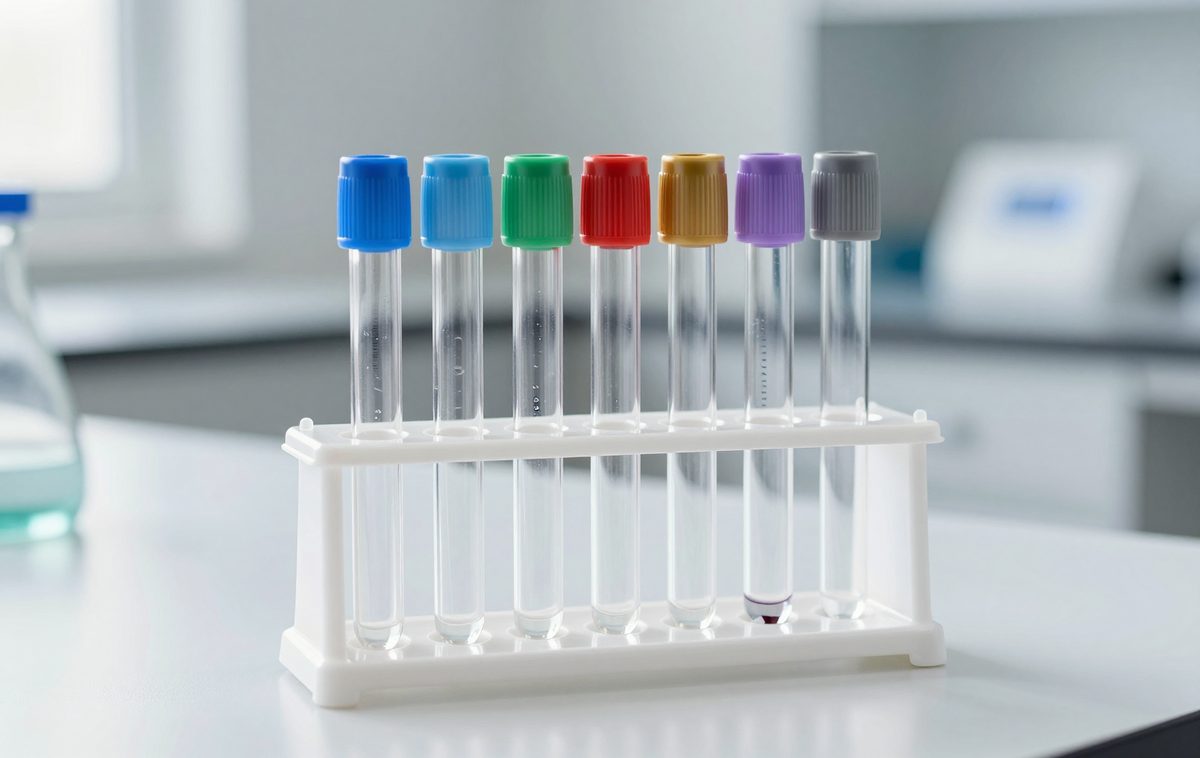
In short. On laboratory tubes the cap colour tells you the additive: light blue is sodium citrate, green is heparin, lavender is EDTA, red and gold are serum tubes. PRP can only be prepared in tubes with an anticoagulant, most often sodium citrate. PRP tubes, however, have no common colour: the ReLife cap is blue, other makers use yellow, white or red. What decides is the label and the registration certificate, not the colour.
Where the colour code comes from
Cap colours were introduced for laboratories that handle hundreds of tubes a day, so that a nurse never draws a coagulation sample into a chemistry tube. The coding is set out in ISO 6710, and major manufacturers broadly follow it. The standard, however, describes tubes for laboratory tests. Devices for preparing plasma for injection are only partly covered, and PRP manufacturers choose their own colours.
What each colour means
| Cap colour | Additive | Laboratory use | Suitable for PRP |
|---|---|---|---|
| Light blue | Sodium citrate, 1:9 with blood | Coagulation tests | Same anticoagulant, but not a PRP device: small volume, no gel, different intended use |
| Black | Sodium citrate, 1:4 | ESR | No |
| Green | Lithium or sodium heparin | Plasma chemistry | No, heparin is not used in plasma therapy |
| Lavender | EDTA | Complete blood count | No |
| Red | No additive or clot activator | Serum chemistry | No, it yields serum, not plasma |
| Gold, yellow with gel | Clot activator and gel | Serum chemistry | No, for the same reason |
| Grey | Sodium fluoride and oxalate | Glucose, lactate | No |
| Yellow without gel | ACD solution: citrate, citric acid, dextrose | Typing, cell work | ACD is used in some PRP systems, the tube must be registered for that purpose |
Shades differ between manufacturers. The table shows the general logic, not a rule for every tube on the market.
Why PRP needs plasma, not serum
Red and gold tubes are designed to let blood clot. Platelets are consumed in the clot, and the serum above it contains almost none. PRP needs the opposite: blood must stay liquid and platelets must remain in the plasma, which is why a PRP tube always contains an anticoagulant. Why that anticoagulant is sodium citrate and not heparin is explained in the article on heparin versus sodium citrate.
Blue PRP tube versus light blue laboratory tube
Both contain sodium citrate and the colours look alike, but they are different devices. A light blue laboratory tube holds 2.7 or 4.5 ml of blood for a clotting test, is not held to the requirements for devices whose contents are injected, and has no gel. The ReLife PRP tube holds 8 ml of blood, contains a separating gel, is a class 2b device and is registered specifically for preparing plasma. A side-by-side table is in the article on sodium citrate vacuum tubes.
How to check a tube without looking at the colour
- Anticoagulant on the label. For PRP this is sodium citrate or ACD. Heparin, EDTA and clot activators do not work.
- Intended use in the registration certificate. It should state preparation of platelet-rich plasma. For ReLife it is Registration certificate RK-MP-5№016078.
- Safety class. A device whose contents are injected into a patient is class 2b.
- Volume and gel. Volume sets how much plasma one tube gives, gel sets how you collect it.
Frequently asked questions
Can PRP be prepared in a green top tube?
No. Green means heparin, which is not used in plasma therapy. ReLife tubes contain sodium citrate only.
What colour is the ReLife cap?
Blue. Inside are sodium citrate and a separating gel, 8 ml, glass, vacuum. Specifications are on the product page.
Are there white PRP tubes?
Yes. The colour is the manufacturer's choice. Check the anticoagulant, intended use and device class on the label and certificate.