
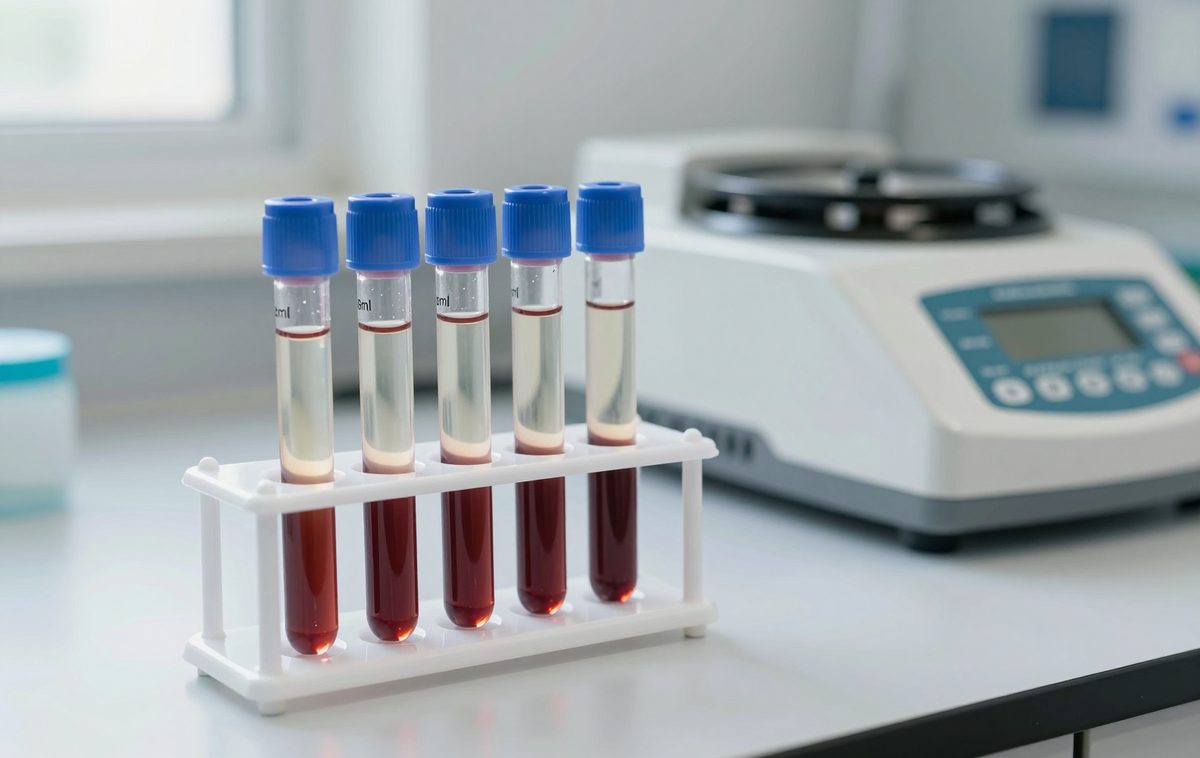
In short. One PRP procedure most often takes one to four 8 ml tubes: the face and a single body area usually fit into one or two, the scalp and a large joint need more. The exact number is set by the physician according to their protocol. This article explains where the figures come from and how to size a purchase so that tubes last a month of work without leftovers on the shelf.
Where the number of tubes comes from
A ReLife tube holds 8 ml of blood. Roughly half of blood volume is plasma, so after centrifugation one tube yields about 3–4 ml of platelet-rich plasma. The exact yield depends on the patient's haematocrit, the centrifuge setting and how much plasma the physician chooses to draw without touching the cell layer under the gel: it is better to leave a millilitre behind than to pick up red cells from the bottom.
From there the arithmetic is simple. The protocol sets a PRP volume per area, that volume is divided by the yield of one tube and rounded up. If the protocol calls for 6 ml of plasma for a joint and a tube yields about 3.5 ml, two tubes are needed. Pooling plasma from several tubes of the same draw is standard practice.
Orientation figures by area
Below are typical ranges found in published protocols and in clinic practice. They are neither a prescription nor a ReLife recommendation: we supply consumables, the treating physician decides the approach. The ranges help a purchaser estimate consumption.
| Area | PRP volume in typical protocols | 8 ml tubes | What changes the number |
|---|---|---|---|
| Face | 3–6 ml | 1–2 | Treated area, technique (papular or cannula), one zone or face with neck |
| Scalp | 6–12 ml | 2–4 | Size of the thinning area, injection density, course protocol |
| Knee joint | 4–8 ml | 1–2 | Joint size, required platelet concentration, leukocyte-poor or leukocyte-rich PRP |
| Shoulder, hip | 4–8 ml | 1–2 | The same, plus ultrasound-guided access |
| Small joints, tendons, ligaments | 2–4 ml | 1 | Usually one injection point, volume limited by the tissue |
| Dentistry, one site | 2–4 ml | 1 | Number of sites per visit, whether a fibrin clot is needed |
| Gynaecology, urology | 4–8 ml | 1–2 | Specialty protocol, number of injection points |
Two tubes per procedure is also the starting assumption in the purchase calculator on this site: it is the middle of the range for most areas. In the calculator you can set your own number of tubes per procedure.
Why one 8 ml tube rather than several small ones
Laboratory citrate tubes of 2.7 or 4.5 ml yield too little plasma, and the physician has to make several draws and pool the contents. Every extra draw is another venepuncture, another risk to sterility and another tube on the invoice. The 8 ml volume is chosen so that one area is covered by one or two tubes. How a PRP tube differs from a laboratory tube is covered in our article on vacuum tubes with sodium citrate.
What else changes consumption
- A course, not a single procedure. In aesthetic medicine and trichology protocols are usually built as a course of several sessions weeks apart. Buy for the course of all patients in the month, not for one visit.
- Activation. If the protocol requires activating the plasma with calcium chloride, the volume in the syringe grows slightly with the activator, but the number of tubes does not change.
- Patient haematocrit. With a high haematocrit a tube yields less plasma. A physician who sees this in the first tube takes an extra one from the same draw.
- Defects and reserve. A tube that lost its vacuum or cracked in the centrifuge is a lost procedure. With class 2b devices this is rare, but a reserve of one box per room is sensible.
Sizing a monthly purchase
Formula: procedures per month × tubes per procedure, rounded up to whole PRP BOX packs of 25. Three examples.
- An aesthetic physician, 20 face procedures a month at one tube each: 20 tubes, one box, 20,000 KZT.
- A trichologist, 15 procedures at 3 tubes: 45 tubes, two boxes, 40,000 KZT, the remaining five tubes go to reserve.
- An orthopaedist, 30 joint injections at 2 tubes: 60 tubes, three boxes, 60,000 KZT.
The price of 800 KZT per tube applies within a PRP BOX pack, tubes are not sold individually direct. Put your own flow into the calculator: it shows the number of boxes and the total at once, and the calculation can be sent to the manager in WhatsApp with one button.
What the tube must contain for the calculation to hold
Volume arithmetic only works with a tube intended for PRP preparation: sodium citrate as the anticoagulant, a separating gel, safety class 2b and a registration certificate in Kazakhstan. For ReLife tubes that is Registration certificate RK-MP-5№016078. How to check these four points when purchasing is covered in how to choose PRP tubes for your clinic, and protocol parameters by specialty are sent to physicians on request from the protocols page.
Frequently asked questions
Is one tube enough for a knee?
If the physician's protocol provides for 3–4 ml of PRP, one 8 ml tube is usually enough. Protocols of 6–8 ml need two. The physician decides by the volume they inject.
How many tubes does a hair course take?
At 2–4 tubes per session and a course of several sessions, one patient takes 6 to 16 tubes. Multiply by the number of patients per month and round up to boxes of 25.
Can plasma from two tubes be combined?
Plasma from tubes of the same draw from the same patient is pooled into one syringe, this is standard practice. Tubes from different patients must never be mixed.
What if the yield is lower than calculated?
Take an extra tube from the same blood draw. That is why a room should keep a reserve beyond the calculation, at least for a few procedures.
Are there tubes of other volumes?
ReLife makes one tube: 8 ml, glass, vacuum, sodium citrate and separating gel. For larger volumes two or three tubes are used rather than a bigger tube.