
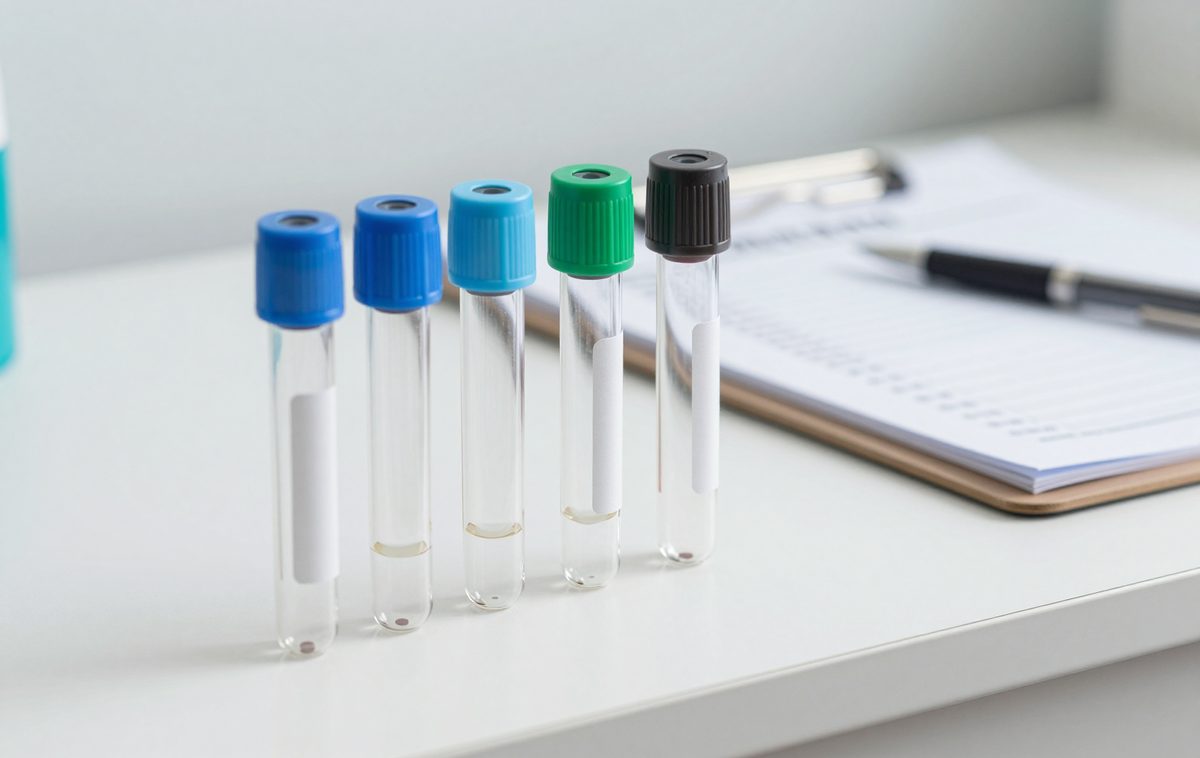
Searching for PRP tube reviews usually returns marketplace star ratings and forum threads where one clinic praises a brand and another complains about it. Neither tells you why. A tube is a class 2b medical device that goes through a centrifuge and whose contents are injected into a patient, so it is better compared on measurable properties than on stars. Below is the framework we use ourselves when someone asks how ReLife tubes stand against others: seven properties, what each one changes in practice, and how to check it before buying.
1. Anticoagulant: sodium citrate or heparin
This is the first line to read on the label. Sodium citrate reversibly binds calcium ions, so the plasma stays liquid in the tube and can be activated later if the protocol requires it. Heparin blocks thrombin directly, does not let clotting recover and can alter the properties of the plasma, which is why it is not recommended for PRP preparation. Some tubes use ACD-A, a citrate-dextrose solution: it is also citrate based. If the label does not name the anticoagulant, that alone is a reason to look elsewhere. Details are in our article on heparin versus sodium citrate.
2. Separating gel
After centrifugation the gel settles between the plasma and the cell fraction. Without it the physician has to pipette very carefully to avoid drawing red cells, and the plasma is more often contaminated. Tubes without gel exist and are cheaper, but they make the procedure longer and the result less repeatable. Check that the gel is stated on the label and is visible in the tube.
3. Safety class and registration
In Kazakhstan and the EAEU a PRP tube is a class 2b medical device: it contacts blood that returns to the patient. Class 2a tubes look the same but do not pass the full cycle of tests for biocompatibility, sterility and pyrogenicity. The registration certificate states the class and the intended use. For ReLife tubes it is Registration certificate RK-MP-5№016078. A laboratory tube registered for in vitro diagnostics is not a PRP tube even if it contains citrate: see vacuum tubes with sodium citrate and why class 2b matters.
4. Body material and centrifuge behaviour
Glass keeps vacuum longer and does not deform under load, plastic is lighter and does not break if dropped. Either can be fine, but the body must be rated for PRP centrifugation. In reviews the complaints that actually matter are cracked tubes, lost vacuum and gel that did not form a barrier: these are body and gel quality issues, not luck. Ask the supplier for the recommended centrifugation parameters for their tube and their rotor type.
5. Volume and plasma yield
Roughly half of blood volume is plasma. An 8 ml tube gives about 3–4 ml of PRP, a 10 ml tube a little more, small laboratory tubes far less. Compare tubes by the volume of usable plasma per tube, not by the nominal size, and by how many tubes your protocol needs per area: we have collected orientation figures in how many PRP tubes per procedure.
6. Sterility, packaging and shelf life
Each tube should come in an individual sterile pack with the sterilisation method, lot number and expiry date printed on it. The contents must be labelled sterile and pyrogen-free. A tube shipped loose in a box of 100 with one common label is a warning sign, whatever its rating.
7. Price per procedure, not per tube
The unit price is the least informative number in a comparison. Count what one procedure costs: tubes per area multiplied by the price, plus the cost of a failed tube if the vacuum or the gel lets you down. A tube that is 20 percent cheaper but needs a second draw once in ten procedures is not cheaper. ReLife tubes cost 800 KZT per tube within a PRP BOX of 25, which for most areas means one to two tubes per procedure.
The comparison in one table
| Property | What to look for | Where to check | ReLife tube |
|---|---|---|---|
| Anticoagulant | Sodium citrate or ACD-A, not heparin | Label, instructions | Sodium citrate |
| Separating gel | Present and stated | Label, visible in tube | Yes |
| Safety class | 2b, intended use: PRP preparation | Registration certificate | 2b, RK-MP-5№016078 |
| Body | Rated for PRP centrifugation | Supplier's parameters | Glass, vacuum |
| Volume | Enough plasma for one area from 1–2 tubes | Label | 8 ml |
| Sterility and packaging | Individual sterile pack, lot, expiry | Pack | Individual pack |
| Price | Per procedure, including failures | Your own calculation | 800 KZT per tube in a box of 25 |
How to read a review when you still want one
- Look for the specialty and the area: a trichologist and an orthopaedist need different volumes and notice different problems.
- Separate device problems from technique problems. Haemolysis and red cells in the plasma are often a centrifuge setting, not the tube.
- Trust reviews that name the lot and the date. A tube changes between batches less often than a supplier changes its source.
- Ask the supplier for a sample box and run it on your own centrifuge before committing to a large order. This is the only review that matters for your room.
Checklist before ordering
- Anticoagulant named on the label, citrate based.
- Separating gel present.
- Registration certificate with class 2b and PRP as the intended use, number verifiable in the registry.
- Individual sterile packaging, lot and expiry on each tube.
- Recommended centrifugation parameters available from the supplier.
- Price counted per procedure for your protocol.
If you want the same list as a step-by-step guide with the ReLife figures filled in, see how to choose PRP tubes for your clinic. Specifications of the tube are on the product page.